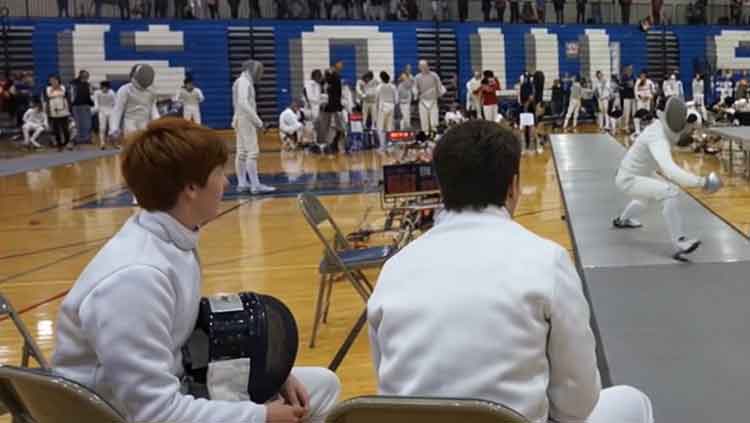
Understanding Team Events
The first thing you'll notice about team events is that fencers love a good team name. Three Tips For You, We Don't Get Your Point, and…Those Guys are all team names I’ve seen.
Explaining the format is a little less fun. If you're used to individual events—first to 5, 10, or 15—the rotating three-fencer structure can feel confusing at first.
This guide is meant to make sense of it. Once you understand how team events are built, the strategy starts to make sense, and so does the appeal.
Team Kitten Mittens and the Epic Comeback
In individual fencing, you only get so much room to recover.
A bad start, a tough matchup, a gap in experience—you can adjust, but the window is limited. You’re solving everything inside one bout, one race to 15.
Team events change that.
You’re not just fencing your own bout, you’re managing a shared score across three people. That opens the door for different kinds of strategy. Different kinds of pressure. And sometimes, different outcomes entirely.
I learned that the hard way with Team Kitten Mittens.
Back in 2017, we had one of those rare local mixed 3-person épée team events. Only complication: my best friend’s wedding was the night before.
I showed up early the next morning on almost no sleep, telling myself I’d figure it out once I got moving. What I figured out pretty quickly is that fencing after a wedding is not a great idea.
My bouts didn’t go well. At all. By the time we got to the anchor leg, we were down by double digits.
But team events aren’t over when one person has a rough day.
Our anchor had a real job—but she also happened to be a national champion. So we did the math. It wasn’t just about outscoring her opponent. She needed to close a gap, manage the clock, and pick the right moments. It became a problem of tempo, distance, and decision-making under pressure.
That’s the shift.
In a team event, you’re not just fencing your opponent—you’re stepping into a situation your teammates helped create. Sometimes that means protecting a lead. Sometimes it means chasing one down, one touch at a time.
And yeah…she did it.
Quick Reference: Team Event Basics
| Aspect | Individual Event | Team Event |
|---|---|---|
| Fencers | 1 per side | 3 (plus optional sub) per side |
| Structure | Bout to 15 | 9 bouts, relay scoring |
| Win Condition | First to 15 | Highest score after 9 (max 45) |
| Bout Length | Up to 3 periods | 3 minutes per bout |
| Strategy | Individual tactics | Lineup + score management |
How Team Events Actually Work
Lineup (What Matters More Than A/B/C)
You'll hear "A, B, C fencers," but what really matters is the order on the bout sheet.
- The team captain sets it before the match
- That order determines the entire rotation
- You're locking in matchups across all 9 bouts
That decision alone can shape the match.
The 9-Bout Rotation
| Bout | Position | vs | Opponent Position | Target |
|---|---|---|---|---|
| 1 | C | vs | C | 5 |
| 2 | A | vs | B | 10 |
| 3 | B | vs | A | 15 |
| 4 | A | vs | C | 20 |
| 5 | C | vs | A | 25 |
| 6 | B | vs | B | 30 |
| 7 | A | vs | A | 35 |
| 8 | B | vs | C | 40 |
| 9 | C | vs | B | 45 |
Each fencer sees each opponent once. The order is fixed.
Relay Scoring (The Part That Feels Weird at First)
The score carries the entire match.
Example:
- Bout 1 ends: 5–3
- Bout 2 starts: 5–3 → fences to 10
- Bout 3 starts: whatever the score is → fences to 15
That's why experienced fencers think of this as nine separate problems, not one long bout.
Time + Targets
Each bout ends when:
- Someone hits the target score, or
- The 3 minutes expire
And yes—all 9 bouts are fenced. No early "we hit 45, we're done."
Substitutions (Not as Flexible as People Think)
You can have a 4th fencer, but:
- The sub must be declared to the director and opponent
- Once they're in, they're in for the rest of the match
- You cannot swap per bout
So it's a commitment, not a rotation tool.
Strategy: What You're Actually Trying to Do
This is where team events separate from individual fencing.
Every bout has context:
- Are you protecting a lead or chasing?
- Do you need touches, or do you need control?
- Is this a moment to take risk, or reduce damage?
- What does the next fencer need from you?
And then lineup:
- Who handles early tone-setting?
- Who fences volatile middle bouts?
- Who anchors under pressure?
A strong anchor can swing a match—but only if the earlier bouts put them in range.
Different Backgrounds, Different Comfort Levels
Coming from collegiate club fencing, this format always felt normal to me. There's more emphasis on:
- Shared strategy
- Team identity
- Working through momentum together
Once I started fencing more open events, it became clear that not everyone has that experience.
You'll see very strong individual fencers who just haven't had many chances to develop that team instinct. And that's not a skill you pick up instantly—it comes from repetition.
Tournament Reality
Most team events are:
- Direct elimination
- Win → advance
- Lose → done
So your day might be short—or it might turn into a full run.
Why It's Worth It
Team fencing changes how you think about the sport.
It's not just:
"How do I win this bout?"
It's:
"What does the team need from me right now?"
- Build a lead
- Hold a lead
- Close a gap
- Keep things manageable
You're stepping into a situation, not starting from scratch.
And once that clicks, team events stop feeling chaotic—and start feeling like one of the most strategic formats in fencing.
Want to learn more about fencing competition structures? Check out our Youth Circuit Guide to understand RYC, SYC, and national championship pathways.
On this page

Sign in to access exclusive resources tailored to your preferences.
Stream Episodes Now
Bladework TV Archives
Unlock access to the only Fencing-themed reality TV show.
Half Sportscast, Half Reality TV, All Fencing.
- Community Track (Pay what you want Access)
- Watch select "Bladework" segments only.
- Competition Track (Subscription Required)
- Unlock the full "Bladework" library.